


Do you feel overwhelmed when trying to decipher your dog’s food label? You’re not alone. Pet food packaging can be crowded with ingredients and buzzwords that make it hard to identify what’s really in the bag. Learning how to read dog food labels is the key to understanding what you’re feeding your dog and choosing a truly quality diet. In this step-by-step guide, we’ll walk you through everything from ingredient lists and guaranteed analyses to marketing claims and sourcing. By the end, you’ll be equipped with pet food label tips to confidently pick the best food (and treats or toppers) for your canine companion.
Remember: an informed dog owner is an empowered dog owner. Let’s break down the label together, so you can make educated decisions and ensure your dog is getting the nutrition they deserve.
Step 1: Understanding the Ingredient List – Real Meat vs. Vague Ingredients
The ingredient panel is the heart of the dog food label. Ingredients are listed in descending order by weight, which means the first few items make up the bulk of the food listed in descending order by weight. Look here first to see where the protein is coming from. Ideally, you want to see a named animal protein at the top of the list – for example, “chicken,” “beef,” or “salmon” rather than something vague like “meat.” Specific real meats and organs (e.g. chicken liver, beef heart) indicate quality, species-appropriate nutrition. These ingredients are rich in essential amino acids, fats, and micronutrients that dogs thrive on.
By contrast, be wary of vague or generic terms in the ingredients. For instance, “meat meal” or “animal by-product” doesn’t tell you much about what animal it came from or what parts are included. “Meat meal” could technically include any mix of animal tissue, and “poultry by-product” might contain anything from nutrient-rich organ meat to low-value scraps. To be clear, not all by-products are evil – some are nutritious organ meats – but the lack of specificity is a red flag. High-quality brands will name the source: e.g. “chicken meal” (made from chicken meat, minus water) is more transparent than “meat meal.” The same goes for fats: “chicken fat” is better than “animal fat.” If the label proudly lists specific organs like liver or heart, that’s a good sign of real organ ingredients being used for nutrition rather than mystery meats.
Another thing to watch for is ingredient splitting, a common trick to make a less-desirable ingredient appear lower on the list. For example, a food might contain a lot of peas (a filler protein source) but list “pea protein,” “pea fiber,” and “pea starch” separately. Individually, each pea component might appear below meat on the list, but combined, pea might actually outweigh the meat. Keep an eye out for multiple forms of the same plant ingredient scattered through the list – that’s a clue the food relies heavily on that filler. In general, the more whole, animal-based items you see at the top, the better the quality. If the first few ingredients are corn, wheat, and soy, it’s a sign of a low-cost, filler-heavy food. On the other hand, if you see named meats and even organ meats leading the list, you’re looking at a protein-rich, meat-based recipe.

Step 2: Decoding the Guaranteed Analysis Panel
The Guaranteed Analysis (GA) is that table of percentages on every dog food label. It’s essentially a nutritional snapshot that guarantees the minimum amounts of protein and fat, and the maximum amounts of fiber and moisture in the food. For example, a GA might say: Crude Protein (min) 25%, Crude Fat (min) 15%, Crude Fiber (max) 4%, Moisture (max) 10%. “Crude” refers to the specific lab method of analysis – it doesn’t mean “low-quality.” This panel helps you understand the basic nutrient breakdown of the food.
Here’s how to use it: Ensure the protein is high enough to meet your dog’s needs (puppies and active dogs generally need more, seniors a bit less). Fat provides energy and should be present in a healthy amount (too low can be a red flag for an overly grain-based diet, but too high isn’t great for less active dogs either). Fiber is typically from plant ingredients; a moderate amount helps digestion, but a very high fiber content might indicate lots of fillers. Moisture will be much higher in canned or fresh foods (which can be 70%+ water) and low in kibble (usually under 12%). If you’re comparing a wet food to a dry food, you’ll need to convert to a dry-matter basis for a fair comparison – but for most cases, comparing two kibbles or two cans side by side, the GA works as-is.
One thing GA doesn’t tell you is the quality of nutrients. For instance, two foods could both say “25% protein,” but in one food that protein might come from bioavailable chicken muscle, while in another it could come largely from pea protein or gelatin – which aren’t as complete for dogs. So use the GA in combination with the ingredient list. Also, check if the food provides extras like omega-3s, glucosamine, or other beneficial nutrients – some brands list those in the GA or elsewhere on the package if they are proud of them.
Many dog foods will also list the calorie content (often as “Calories: X kcal/cup”). Use that information to portion correctly for your dog’s size and activity level. And importantly, look for an AAFCO nutritional adequacy statement near the GA (more on that in Step 3 and 4) – the GA tells you what’s in the food, but the adequacy statement will tell you if it’s sufficient as a standalone diet.
Step 3: What Packaging Claims Really Mean (Decoding Marketing Buzzwords)
Dog food labels are full of marketing claims – some meaningful, some just hype. It’s crucial to understand the common terms so you aren’t misled by a pretty sticker on the bag. Let’s translate some of the big ones:
-
“Complete and Balanced”: This phrase isn’t just marketing; it’s a legal nutritional claim. If a label says the food is complete and balanced, it must meet the nutritional standards established by AAFCO for a given life stage (adult maintenance, growth, all life stages, etc.). In other words, the food is formulated to provide all the nutrients a dog needs. Always look for this statement if you’re feeding the food as your dog’s main diet. If it’s missing, or it says “for intermittent or supplemental feeding”, the product is not meant to be a sole source of nutrition.
-
Natural: In pet food, “natural” generally means the ingredients are derived from plant, animal, or mined sources and haven’t been chemically synthesized. It implies no artificial preservatives, colors, or flavors were added (except in the trace amounts necessary for things like added vitamins or minerals). However, “natural” doesn’t speak to quality or freshness – a natural ingredient could still be low-grade. Think of this term as “no synthetic additives.” It’s positive to see, but you’ll want to verify that the food indeed uses natural preservatives, like mixed tocopherols/Vitamin E, instead of chemicals like BHA or BHT.
-
Human-Grade: This claim has gained popularity and does have a strict meaning. A “human-grade” dog food must be made entirely from ingredients fit for human consumption and produced in a facility licensed to make human food. Essentially, if you see human-grade, it means the company could legally serve that food to you for dinner (whether or not you’d want to taste it is another matter!). This speaks to very high ingredient quality and safety standards. Keep in mind, human-grade foods can still be nutritionally balanced or unbalanced, junk food or healthy – but generally if a brand goes to the trouble of being human-grade, they are aiming for high quality.
-
“With Real Meat”: Phrases like “made with real beef” or “with real chicken” are plastered on many packages. It sounds great – of course you want real meat. But here’s the catch: “With” has a specific regulatory meaning. A product that says “with beef” only needs to contain at least 3% beef by weight. That’s it – just 3%. So a bag labeled “Dog Food with Real Chicken” could be 3% chicken and 97% other stuff. Don’t be fooled by the big bold “WITH”; always check the actual ingredient list to see how high that meat is listed. Contrast that with a product named just “Beef Dog Food” – by AAFCO rules, that would have to be about 95% beef (or 70% beef with water counted) to use that name. The wording matters a lot. If the label uses terms like “Dinner,” “Entrée,” or “Platter” (e.g. “Chicken Dinner for Dogs”), that generally indicates around 25% of that ingredient. But “with X” is only 3%. A tiny tweak in phrasing can make a huge difference in formula, so read past the front-of-bag claims.
-
Grain-Free: “Grain-free” foods omit grains like wheat, corn, rice, barley, etc. This can be beneficial for dogs with specific grain allergies or for owners who prefer a more ancestral-style diet. However, grain-free isn’t automatically better. In many grain-free kibbles, starches like peas, lentils, potatoes, or tapioca simply replace the grains. These ingredients are carbohydrates too and don’t make the food meatier by default. In fact, in recent years grain-free diets have been scrutinized for a possible link to heart disease in dogs, likely due to high legume content. The takeaway: if you choose grain-free, do it for the right reasons (actual sensitivities, personal philosophy) and still scrutinize the rest of the ingredients. “Grain-free” should not be an excuse for a food to be low in protein or high in other fillers. Conversely, “grain-inclusive” diets can be perfectly healthy and nutritious if the grains are balanced with quality animal ingredients.
-
Premium, Holistic, Gourmet, etc.: Terms like “premium,” “super-premium,” “holistic,” and “gourmet” have no legal definition in pet food. Any brand can slap these words on a bag. Don’t let them sway you without evidence. They’re basically marketing fluff. Instead, judge by the actual ingredients and analysis. The same goes for “Vet Recommended” – unless the company can back it up (for example, a survey of vets or a specific vet nutritionist developed it), it’s usually just a sticker.
In short, understand that the front of the package is marketing; while the back, with its ingredient list and analysis, is where the truth is. Use the claims on the front as clues, but always verify by reading the details we’re outlining in this guide. For example, if a bag boasts “All Natural, With Real Beef,” you now know to confirm that it indeed has natural preservatives and check whether beef is predominantly present or just a 3% token. When you see “human-grade,” you can feel confident the company is adhering to higher standards. And whenever a claim confuses you, check the brand’s website or reach out for clarification – a transparent, trustworthy company will gladly explain what their buzzwords mean in plain language.
Step 4: Common Red Flags and Ingredients to Avoid
Just as there are positive signs of quality on a label, there are also red flags and ingredients you’ll want to avoid. Some of these we’ve touched on, but let’s compile a clear list of warning signs when evaluating a dog food label. If you spot several of these, you may want to steer clear:
-
Unidentified “mystery” meats or fats: If you see terms like “meat,” “meat meal,” “animal fat,” or “poultry by-product” without the species named, that’s a red flag. It indicates a generic mix that can vary batch to batch. Reputable foods will specify the animal source (e.g. “chicken by-product meal” at minimum, or preferably “chicken liver,” “turkey meal,” etc.). Vague meat ingredients could come from very low-quality sources.
-
Excessive use of fillers: Fillers are ingredients with low nutritional value used to bulk up the food cheaply. Common ones include cereal by-products (like wheat middlings, rice hulls, peanut hulls), large amounts of corn or soybean meal, and other cheap starches. Some fiber is good for digestion, but if the ingredient list is full of plant fillers and very light on animal protein, that’s not ideal. Identifying fillers in dog food is easier when you know their names – for example, ingredients ending in “hulls” or “pomace” (like apple pomace) are often just fiber waste. A quality food won’t rely on empty fillers to meet volume; it will be packed with more nutrient-dense ingredients.
-
Artificial preservatives and additives: Avoid foods that use synthetic preservatives like BHA, BHT, or ethoxyquin. These chemicals extend shelf life, but they have been flagged as potential carcinogens and have been banned or limited in certain countries. There are plenty of natural alternatives (e.g. Vitamin E/tocopherols, rosemary extract.) that high-quality brands use instead. Similarly, artificial colors (e.g. Blue 2, Red 40, Yellow 5) have no place in your dog’s bowl – they’re only there to make the kibble look “fun” to humans, and some have been linked to hyperactivity or other issues. Dogs don’t care about the color of their food! Titanium dioxide (a whitening agent) is another additive to skip. Opt for foods that skip artificial flavors as well – real meat as the first ingredient doesn’t need fake flavor enhancers.
-
Sweeteners or excess salt: Believe it or not, some dog foods - especially lower-end ones and treats - add sugar, corn syrup, fructose, or other sweeteners to make the food more palatable. While not outright toxic, added sugars are absolutely unnecessary and can contribute to obesity and dental problems. Salt is essential in small amounts, but if salt appears at the top of the ingredient list, the food might be very salty. That’s not healthy long-term. Your dog’s food shouldn’t taste like a candy bar or a bag of chips.
-
“Ingredient splitting” and deceptive order: As mentioned earlier, splitting one ingredient into components (e.g., listing corn flour, corn gluten, and corn meal separately) is a tactic to hide how much of the food is actually corn. Scan the list for any repeated words like “pea, pea, pea” in various forms or multiple types of essentially the same grain. This trick is a red flag for a formula trying to appear more meat-based than it truly is.
-
Lack of nutritional adequacy statement: If the label does not have a statement like “This food is formulated to meet the nutritional levels established by the AAFCO Dog Food Nutrient Profiles for maintenance/all life stages/etc.,” and instead says something like “for intermittent or supplemental feeding only,” you should not use that product as your dog’s primary food. It’s either a treat, topper, or a specialty item. Using a non-balanced food as a daily diet can cause deficiencies. Many excellent toppers and treats will have the “supplemental” label – that’s fine as long as you know their role. But your dog’s main meal should always be complete and balanced.
-
Outrageous claims or lack of transparency: This one is more subjective, but be cautious of any food that markets itself as a “miracle cure” or uses a lot of buzz without backing it up. For example, if a bag brags about a “Revolutionary proprietary blend” but doesn’t actually tell you what’s in that blend, that’s not a good sign. You have a right to know what you’re feeding your dog. Also, if a brand’s label or website is scant on details (no info about sourcing, who formulates their diets, or how they test quality), that lack of transparency is a red flag in itself. Trustworthy companies are proud to share details (and problems occur even to good brands, but they’ll be open about addressing them). If something feels hidden or too good to be true, dig deeper or consider other options.
In summary, when scanning the label, make a checklist of the dog food ingredients to avoid and the warning signs. Finding one of these in an otherwise decent food might not be a deal-breaker, but if you start seeing multiple red flags piled up – say, a food with “meat and bone meal” as the main protein, “animal fat” unspecified, BHA preservative, and three kinds of corn – you know this is not the quality nutrition your beloved dog deserves. The good news is that many brands are moving away from the worst offenders, especially at the premium end of the market. As a savvy label reader, you can spot those old-school cheap ingredients and choose better for your pet.

Step 5: Why Sourcing and Transparency Matter
Ingredients are one thing – but where do those ingredients come from? The pet food label may not always spell it out, but responsible brands will often include hints or statements about sourcing on the packaging or their website. And as a careful dog owner, you should care. The quality of the source (and the honesty of the company) directly impact the quality of the food.
First, consider the source of the proteins. There’s a big difference between, say, “beef” sourced from a questionable supplier and beef sourced from a human-grade, USDA-inspected facility. Was that chicken meal made from clean, wholesome cuts, or from rejected scraps? Is that “fish” wild-caught from clean waters, or random fish waste? Premium foods often highlight sourcing: terms like “grass-fed beef,” “free-range chicken,” “wild-caught salmon,” or “pasture-raised” are signals of higher-quality source animals. For example, grass-fed beef organs contain more omega-3 fatty acids and vitamins than feedlot beef organs. Your dog might not know what “grass-fed” means, but their body will benefit from the richer nutrient profile of meat raised on its natural diet. And ethically, many dog owners prefer knowing the animals were humanely raised. If a company never mentions how or where they source meat, it could be because there’s nothing impressive to tell.
Next, look for country of origin information. The label will list where the food is manufactured (e.g. “Made in the USA” or “Manufactured in Canada”), which is helpful. But “made in” doesn’t always mean all ingredients came from that country. Ideally, find brands that are transparent about sourcing each major ingredient. Ingredients from countries with strong safety regulations (USA, Canada, New Zealand, Australia, much of Europe) tend to be safer. In the past, some pet foods with ingredients sourced from countries with lax regulations faced recalls (for instance, the 2007 melamine contamination in wheat gluten from China). This isn’t to demonize any one country, but transparency is key: you should know if the salmon oil is from Alaska or if the vitamins are from Europe, etc. Many high-end brands will say “All ingredients sourced in the USA” or “Meat sourced from New Zealand, fruits and veggies from local US farms,” etc. If you can’t find any sourcing info at all, that’s a clue that cost was the primary driver (they may be buying on the global commodity market for the cheapest price, with a minimal focus on quality).
Transparency goes beyond just where ingredients come from. It also includes the company being open about how the food is made and tested. Do they own their manufacturing plant or use a trusted partner? Is the facility USDA or FDA inspected? Do they test each batch for pathogens or toxins? A reputable brand will often share these details on their website or even on packaging (“small batch production,” “lab-tested for purity,” etc.). If a brand is proud of their processes, they’ll say so. When you’re investing in your dog’s health, you want to buy from a company that’s equally invested in quality control.
Finally, transparency extends to the label itself. A clean, straightforward ingredient list (short and understandable) reflects a philosophy of openness. By contrast, a very long list with many additives, or things like “proprietary blend” without disclosing components, reflects a “hide the details” approach. For instance, some inexpensive topper products will just list “Proprietary flavor blend” instead of naming ingredients – that’s not the kind of transparency we want.
Let’s illustrate the importance of sourcing and transparency with an example from our own experience. At Brothhh, we believe so strongly in high-quality sourcing that we shout it from the rooftops. Our beef organs are 100% pasture-raised, grass-fed cattle from Argentinian farms – no hormones, no harmful pesticides. We manufacture in the USA under strict quality control. We put this information on our website’s About Us page and product literature because we want dog owners to know exactly what they’re getting. We know that we love dogs more than humans, and that’s why we hold our ingredient standards to levels even people food sometimes doesn’t meet. When you read a brand’s label or visit their site, look for that kind of openness. If a company is willing to say, “We source our lamb from New Zealand free-range flocks” or “Each batch is tested for Salmonella and listeria,” it shows a commitment to quality and safety.
In summary, don’t just read what ingredients are in the food – dig into where they come from and how the food is made. A dog food could look great on the label, but still use cheap, low-grade sources. On the flip side, a food with truly great sourcing will often translate into better nutrition and fewer contaminants. Sourcing and transparency might not be flashy, but they are the backbone of a trustworthy pet food. Your dog depends on you to choose a food that’s not only nutritionally complete but also safe and clean. A little homework on sourcing goes a long way to ensuring that.
Step 6: Real Organ-Based Toppers vs. Standard Fillers – Quality Comparison
To truly understand how to evaluate dog food labels for real organ ingredients versus fillers, let’s look at a specific scenario: meal toppers. Toppers and mixers are products you add to your dog’s regular food to enhance flavor or nutrition. The market is full of them – but they are not all created equal. Some are essentially powdered or sauced junk food, while others are concentrated sources of real nourishment. The difference all comes down to the label.
Imagine two different toppers:
Topper A: It’s marketed with a picture of a hearty stew on the package. Turn to the ingredient list, and you find something like: “Chicken broth, glycerin, natural flavor, caramel color, chicken by-product meal, salt, corn syrup, potassium sorbate (preservative)...” – and a long list of other additives. This is a made-up example, but it’s not far off from many gravy or powder style toppers out there. What do we see? The first ingredient might be broth (mostly water), followed by glycerin (a sugar alcohol used to keep it moist), “natural flavor” (could be a meat digest to simulate taste), then a vague meat by-product meal, and even corn syrup (sugar) for palatability. This topper is mostly filler and flavoring. It might make your dog’s kibble taste like rotisserie chicken, but nutritionally it’s giving almost nothing beneficial – in fact, it’s adding sugar and salt your dog doesn’t need.
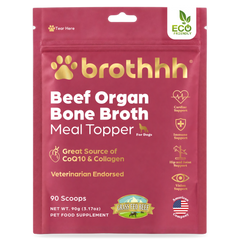
Topper B: Now consider a different product. The ingredient list reads: “Beef liver, beef heart, beef kidney, beef pancreas, beef spleen, bone broth.” That’s it – just freeze-dried organ meats and bone broth in powdered form. This is an organ-based topper (very much like our own Brothhh Beef Organ Bone Broth Complex). In this case, every ingredient is a real, species-appropriate food item. Organs are some of the most nutrient-dense foods on the planet, packed with vitamins, minerals, and protein. Bone broth provides natural collagen, glucosamine, and hydration. This topper isn’t just a taste enhancer – it’s a nutritional boost. When you sprinkle this on your dog’s meal, you’re essentially mimicking what a wild canine might eat when they consume a whole prey animal (muscle meat + organs + connective tissue broth). There are no empty calories here, no glycerin or weird additives – it’s all substance.
The labels of these two products tell the story. Topper A is a typical filler-laden product where the label reveals lots of unnecessary extras. Topper B’s label shows transparency and simplicity: real organs you recognize. As a dog owner reading labels, you want to choose products that lean toward Topper B’s philosophy. Even if you’re just looking at a treat or a kibble topper, read that ingredient list. If it’s as long as a chemistry textbook, that’s a bad sign. If it reads like a home recipe (“salmon, sweet potato, carrots” for a treat, or “beef liver” for a single-ingredient treat), that’s excellent.
Now, organ meats in particular deserve a shout-out. High-quality organ-based products can be a game-changer for your dog’s nutrition. Ingredients like liver, heart, kidney, etc., are rich in things like Vitamin A, B-vitamins, iron, taurine, CoQ10 – nutrients that support vision, heart health, red blood cell production, and more. Fillers like corn or wheat can’t compete with that. So when you evaluate dog food labels, give extra points to foods or supplements that incorporate organ meats in a clear way. Conversely, be skeptical of products that try to mask poor ingredients behind proprietary blends. We’ve seen labels that say something like “Proprietary Nutrient Mix (spray-dried animal plasma, flavorings, etc.)” – which is basically a fancy way of hiding ingredients. We prefer honesty: if a product uses real beef liver, it will just say “beef liver.” If it’s using something like “animal plasma,” you as the consumer should know (and frankly avoid it if you’re seeking the best nutrition).
At Brothhh, for example, we don’t hide behind blends. Our organ-based topper lists each ingredient plainly, and there are only six of them. No fillers, no flavorings, no colorings – nothing artificial. We want you to see that label and nod in approval because you recognize everything on it. Many mass-market toppers and even some foods can’t say the same. They’d rather you not count how many ingredients they’ve packed in, or wonder what “digest” or “by-product” specifically means.
The bottom line for this section: whether it’s a main food or a supplemental topper, reading the label will quickly tell you if you’re dealing with a nutrition-packed product or a filler-filled impostor. If you see organ meats, named meats, and a short list of whole food ingredients, you’ve got something worthwhile. If you see lots of starches, sugars, and mystery meals, it’s basically doggy junk food. Your dog might still gobble it up – dogs have been known to love the equivalent of fast food – but in the long run, it won’t support their health like a cleaner product would. Given the choice, always opt for real, recognizable nutrition over fillers. Your dog’s health and vitality will be the proof that reading those labels and choosing wisely was worth it.
Step 7: Putting It All Together – Apply Your Label Reading Skills
You’ve made it through the nitty-gritty details of dog food labels, and now it’s time to put that knowledge to use. The next time you’re in your pantry or at the pet store, pick up a bag or can of dog food and really inspect the label. You might be surprised at what you find. To help you practice, here’s a quick checklist of things to look for and questions to ask as you evaluate any dog food label:
-
What are the first 3-5 ingredients? Are they quality animal proteins (“chicken, chicken meal, eggs”) or are they dominated by fillers (“corn, wheat middlings, soybean meal”)? The foundation of the food should be protein and fat sources that a carnivore will thrive on.
-
Are real meats/organs named clearly? Check for specific terms like “turkey,” “beef liver,” “salmon meal” and so on. Lack of specificity (just “meat” or “poultry by-products”) is a warning sign. Seeing organ meats or fish oil or egg in the list is a bonus – those are real foods that add value.
-
Are there any ingredients to avoid present? Scan for the bad guys we discussed: artificial preservatives (BHA, BHT, ethoxyquin), artificial colors, generic “animal” fats or proteins, added sugars, excessive salt, propylene glycol, etc. A small amount of one minor additive might not kill the deal, but multiple ones definitely knock a food out of the running.
-
Does it meet AAFCO standards? Find the nutritional adequacy statement to ensure the food is complete and balanced for your dog’s life stage. If it’s a treat or topper, that’s fine – just know its role. But your dog’s main diet should always be AAFCO-approved for maintenance or all life stages.
-
What claims are on the bag, and do they hold up? If the bag says “natural” or “high protein” or “with real beef,” verify those claims in the ingredients and analysis. You now know how to decode each of those. Don’t take marketing at face value – prove it by the label.
-
Is the company transparent? This one you might answer by a quick look at their website if not evident on the label. Do they openly share info about sourcing (e.g. “made in the USA with regionally sourced ingredients”) or have a philosophy explained? A company that stands behind their product usually provides more information rather than less.
Using the checklist above, evaluate the foods you have at home. You might discover that one of your brands is truly top-notch! Or you might realize that the “premium” kibble you trusted is actually full of corn and by-products – in which case, it might be time to upgrade when the bag is empty. The goal is not to make you paranoid, but to empower you to make better choices. Small improvements in your dog’s diet can lead to significant gains in their health over time.
As an example exercise, consider taking a look at our product’s label and info now that you’re an expert label-reader. Check out the ingredient label of Brothhh’s Beef Organ Bone Broth Complex meal topper and see how it aligns with everything we’ve discussed: you’ll find a short, transparent ingredient list with nothing but real, wholesome organ meats and bone broth. That’s by design – we built it to be exactly the kind of product we wished existed. For an even deeper dive, we invite you to visit our Science page, where we break down each ingredient’s nutritional benefits and the research behind them. You’ll see why we chose each component and how it helps your dog - in plain English, no smoke and mirrors. This level of openness is what you should expect from any brand that has your pet’s best interest at heart.
Choosing quality dog food ultimately comes down to knowledge and vigilance. Now that you know how to read and interpret dog food labels, you have the tools to cut through marketing noise and focus on what matters: real ingredients, adequate nutrition, and trustworthy practices. Your dog is family, and feeding them isn’t an area to compromise on. By applying these label-reading skills, you’re ensuring that every meal you serve is one that will nourish them wholly and honestly. That means more energy, shinier coats, stronger immune systems, and hopefully more years by your side.
So go ahead – pull out that bag of kibble or can of food and read it like a pro. Inspect new products before you buy. Ask questions of manufacturers if something isn’t clear. With each label you analyze, it will get easier to spot the gems and call out the junk. Your canine companion may not be able to say “thank you” for taking the time to do this homework, but you’ll see the thanks in their vitality and happiness. Here’s to being a confident, informed dog owner and to our dogs enjoying the best nutrition possible, one label at a time!

Leave a comment
This site is protected by hCaptcha and the hCaptcha Privacy Policy and Terms of Service apply.